
Roberta Colombari, Head of Market Analysis and Competitive Positioning at Leonardo’s Electronics Division and a member of the Board of Directors of DLTM
We are launching this new column dedicated to members of the Ligurian Marine Technologies District with an interview with Roberta Colombari, Head of Market Analysis and Competitive Positioning at Leonardo’s Electronics Division and a member of the Board of Directors of Dltm, who outlines the group’s present and future.
– In the meantime, let us introduce Leonardo: how many sites does it operate, how many employees does it have, and what are its divisions and trends?
Leonardo is now one of the leading international industrial groups in the aerospace, defence and security sectors. The company develops multi-domain technologies and capabilities in support of global security, operating in strategic sectors such as Electronics, Helicopters, Aeronautics, Cyber & Security and Space. It has over 62,000 employees worldwide and operates in 150 countries, including through subsidiaries, joint ventures and equity investments. Its main industrial bases are in Italy, the United Kingdom, Poland and the United States, countries in which the Group has a particularly significant manufacturing and technological presence. Leonardo works alongside governments, defence authorities, institutions and businesses, contributing to major international strategic programmes.
In Italy, the company operates in 16 regions with more than 55 production sites, employs more than 38,000 people and generates economic activity involving over 125,000 people, including direct employees, partner companies and the wider supply chain. A key aspect is precisely its links with Italy’s industrial, scientific and technological ecosystem: Leonardo works in close collaboration with manufacturing clusters, universities, research centres and specialist expertise spread across the country.
– Leonardo has a long-standing connection with the city of La Spezia and the region of Liguria: what does the former Oto Melara site mean to the company?
Leonardo’s La Spezia plant, which employs over 1,530 people, represents a highly valuable industrial and technological hub for the company, with strong links to the history of OTO Melara, founded in 1905. It is a site that preserves and develops distinctive expertise in the development, production and integration of naval and land defence systems, as well as in the development and production of guided munitions electronics – a sector in which Leonardo is the sole manufacturer in Europe. Over the years, more than 2,500 defence systems have been delivered from La Spezia to more than 70 countries worldwide. This confirms the plant’s importance not only for the Liguria region but also for the company’s international standing. The site also houses a centre dedicated to training customers and end-users, which utilises immersive virtual reality for training activities, particularly in the field of maintenance.
In La Spezia, the CIO consortium (IDV – OTO Melara), a Leonardo company, also manufactures next-generation land defence platforms and is responsible for final assembly and functional and vehicle testing.
The La Spezia plant is also the operational headquarters of the Leonardo Rheinmetall Military Vehicles (LRMV) joint venture. This is where the new main battle tanks for the Italian Army are assembled, using components sourced from at least eight Leonardo plants located throughout Italy.
As further evidence of its ties to the local area, mention should also be made of the Melara Museum Association, based in La Spezia, which was founded in 1985 and is now part of the Integrated Museum and Archive System coordinated by the Leonardo ETS Foundation. The Association pursues cultural and social objectives in the field of promoting and preserving the historical legacy of the former OTO Melara.
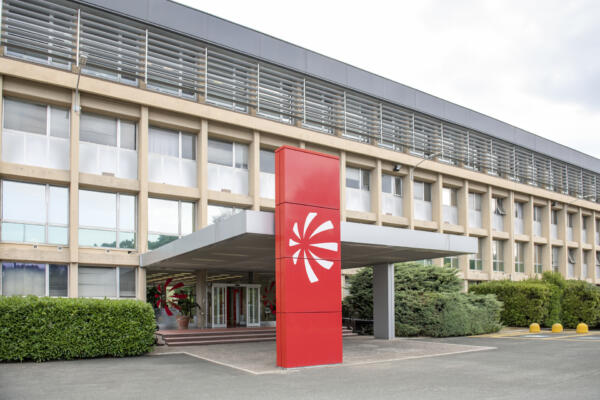
The Leonardo plant in La Spezia
– The La Spezia branch isn’t the only one in Liguria: let’s tell our readers about the areas of excellence at your branches across the region and how these contribute to the growth of the local economy (employment, related industries, etc.)
Leonardo has a long-standing and deeply rooted relationship with Liguria, built on the expertise, products and technologies that the region has been producing since the beginning of the last century. Today, this presence represents not only a leading industrial hub, but also a tangible driver of development for the regional economy.
With over 3,360 employees at its sites in Genoa and La Spezia, Leonardo is at the heart of a manufacturing ecosystem involving around 230 local businesses and helps to generate highly skilled employment, totalling 7,200 jobs across direct, indirect and related sectors. This contribution goes beyond mere figures: the Group’s presence fosters the development of specialist skills, supports the growth of the supply chain and strengthens the region’s ability to compete in high-tech sectors.
The facilities in Genoa are centres of excellence in strategic fields such as electronics, automation, artificial intelligence and cyber security. They are home to high value-added activities that contribute to the digital and technological transformation of the industrial sector, with positive knock-on effects for the local economy as well.
As well as the Leonardo site, La Spezia is also home to a significant presence of MBDA, a consortium in which Leonardo holds a stake alongside BAE Systems and Airbus; furthermore, Orizzonte Sistemi Navali, a subsidiary of Fincantieri and Leonardo based in Genoa and also with a presence in La Spezia, operates in Liguria.
Leonardo’s contribution also stems from its active participation in innovation networks. As well as being a member of the DLTM, Leonardo is involved in numerous Ligurian consortia, including SIIT (Sistemi Intelligenti Integrati S.c.p.a.) and the Start 4.0 Competence Centre, and is one of the key players in the National Underwater Cluster.
Collaboration with the worlds of education, research and institutions is also crucial. Leonardo works with universities and technical colleges (ITS), the Italian Institute of Technology, the Digital Innovation Hub and numerous local organisations, including the Fondazione Ricerca & Imprenditorialità, Confindustria Genova and Confindustria La Spezia. This ongoing dialogue helps to bring industry, research and skills closer together, whilst also contributing to the development of the professional profiles required by new technological challenges.
This connection with the local area is also reflected in the promotion of industrial heritage. In 2000, the Ansaldo Foundation was established by Leonardo, the Liguria Region, the Municipality of Genoa and the Metropolitan City of Genoa; for over 20 years, it has been working to restore, protect, preserve and promote the historical and cultural heritage of companies that have operated and continue to operate in the Liguria region.
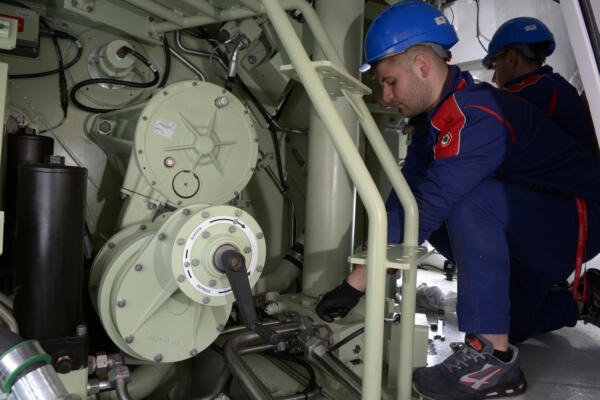
Leonardo plant in La Spezia, shipbuilding production line
– The pursuit of innovation and the drive for development are shared by DLTM and Leonardo: with this in mind, what further opportunities for collaboration might arise between the two organisations?
The sea is one of the country’s major strategic infrastructures: according to the 13th National Report on the Maritime Economy 2025, in Italy the Blue Economy generates €76.6 billion in direct added value and rises to €216.7 billion when taking into account the value generated in the rest of the economy, equivalent to 11.3 per cent of national GDP. It also involves 232,841 businesses and 1,089,710 employees. In this context, Liguria naturally plays a leading role. But the sea is not only central to the economy: it is also central to security, because an increasingly significant part of the stability of territories and global relations depends on port infrastructure, trade routes, submarine cables, energy resources and underwater spaces. This applies to a region such as Liguria, which faces the Mediterranean and is closely linked to the maritime sphere, but it also applies on an international scale, where control of the maritime and underwater domains is increasingly crucial for the protection of people, critical infrastructure and strategic interests.
For Leonardo, therefore, the sea is not merely an operational arena, but a strategic domain in which security, innovation, industrial development and technological competitiveness are intertwined. It is an arena in which many of the development priorities to which the company is committed converge: digitalisation, advanced sensor technology, cyber security, artificial intelligence, autonomous systems, sustainability and the ability to operate in an integrated manner across different domains.
In this context, the DLTM plays a particularly important role, as it brings together large enterprises, SMEs, universities and research centres within a framework of shared project development. It is precisely this ability to foster collaboration – including through an international network – that opens up further opportunities for cooperation: from applied research to the development of new technologies, from harnessing local expertise to the creation of joint initiatives capable of strengthening the Ligurian and national Blue Economy supply chain.
For Leonardo, participation in the DLTM also means actively contributing to an innovation ecosystem capable of transforming ideas, skills and technological needs into concrete projects. Leonardo’s presence within the District – as also confirmed by the comments of the DLTM’s Technical Director – demonstrates the company’s commitment to playing an active role in this process.
Alongside the technological aspect, another key area of collaboration concerns young people and training. The company is growing: at the La Spezia plant alone, over 430 people with an average age of 31 have been recruited in the last two years. This figure confirms just how important it is to continue investing in attracting, developing and nurturing young talent, by creating pathways that bring together training, research and business. In this context, initiatives such as the Seafuture Awards, organised by the DLTM, represent a valuable opportunity. This international award recognises young talent and innovative projects in the field of marine technologies and the Blue Economy, whilst also serving as a forum for the exchange of ideas, expertise and potential avenues for development.
– Your company is growing rapidly: in what direction is innovation heading to meet the challenges of the market?
For Leonardo, innovation is a key driver of industrial growth and competitiveness. In 2025, the Group invested 3 billion euros in Research and Development, with the aim of strengthening its products, services and technological capabilities with a view to long-term sustainability.
The direction is that set out in the Business Plan: to develop technologies that are increasingly digital, interoperable and multi-domain, capable of responding to complex scenarios and ever-evolving security requirements. Innovation, therefore, is not an activity separate from the business, but an integral part of the Group’s ability to compete in international markets, improve efficiency, anticipate customers’ needs and generate value for the entire industrial ecosystem.
This approach draws on a structured internal ecosystem, involving, on the one hand, the engineering and R&D departments of the Group’s divisions and companies, and, on the other, the Leonardo Innovation Labs – central laboratories set up to anticipate technological developments and transfer them to the various business areas. A key enabler of this initiative is the DaVinci High-Performance Computer. Located in Genoa, the DaVinci supercomputer is currently being upgraded and will soon have 30 petabytes of memory and 20 petaflops of computing power. Its performance rises to 1.2 exaflops for 8-bit operations, which are typical of artificial intelligence applications. Featuring an architecture that combines the flexibility of the cloud with supercomputing capabilities, DaVinci is one of the world’s most powerful HPC systems in the aerospace, defence and security sectors. Its computing power enables the use of advanced algorithms – from deep learning to artificial intelligence – the management of large volumes of data and the simulation of complex scenarios, thereby accelerating analysis, design, development and technological validation activities.